The landing page vs homepage decision becomes confusing when you send every visitor to the same destination. A general business introduction may not answer the specific question raised by an advertisement or email.
If the page does not confirm the expected offer, readers must search again for details or interpret a different message. A focused campaign can lose clarity before the visitor reaches its next step.
This guide helps you choose a homepage for broad orientation or a dedicated campaign landing page for a specific offer. Here, landing page means a campaign page; in analytics, it can also mean any page where a visit begins.
Landing Page vs Homepage: The Quick Comparison
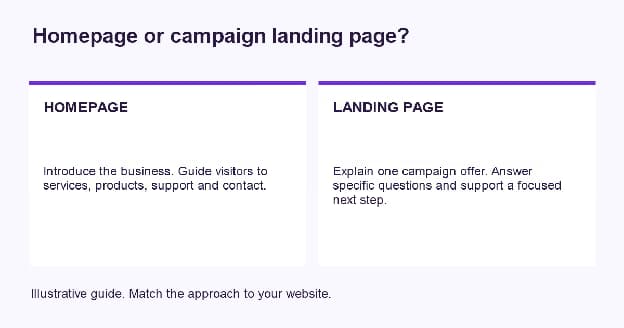
- Homepage: Broad introduction, varied visitor needs, and routes to multiple areas.
- Campaign landing page: Specific message, narrower audience, and a focused action.
- Homepage traffic: Brand searches, direct visits, and general referrals.
- Landing page traffic: A specific advertisement, email, event, or campaign link.
- Both: Accurate content, accessible controls, relevant evidence, and reliable forms.
When a Homepage Is the Right Choice
A visitor searching for your brand may want to understand the business, find support, or browse different services. The homepage should accommodate those needs without forcing everyone into the same campaign. It acts as an orientation point rather than a sales script for one offer.
For example, a design agency's homepage might direct visitors to service categories, project examples, and contact information. A returning client may need a support route, while a new prospect wants to assess suitability. Removing every navigation option can make those tasks harder.
Use the homepage when the entry message is broad or the visitor's next task is uncertain. Keep its main offer clear, but provide sensible choices. The page should explain enough to guide selection without duplicating every detail page.
When a Landing Page Is the Right Choice
A dedicated landing page is useful when the campaign makes a specific promise. If an email promotes a workshop, the destination should immediately explain that workshop, its audience, requirements, and registration process. A general homepage makes the reader search again for the offer they expected.
The landing page can concentrate on the campaign's important questions. Include relevant proof, transparent conditions, and a direct next step. Focus does not mean withholding necessary information. Visitors still need to understand price, availability, delivery, or what happens after submitting a form.
A landing page is not automatically a better choice because it has fewer links. Some visitors need policy, support, or accessibility routes. Remove irrelevant distractions while preserving information required for an informed decision.
Match the Message to the Entry Point
Compare the advertisement or email with the first screen of the destination page. Do the headline, offer, audience, and conditions agree? If the campaign says 'book a local installation visit', the page should not begin with a vague overview of all company divisions.
Keep terminology consistent. Switching from 'free consultation' to 'request a proposal' may confuse visitors if those are different steps. Explain the next action accurately rather than making a button sound easier than the workflow it opens.
This message-matching review is an editorial exercise, not proof of a particular conversion increase. Validate the result through visitor-task testing and appropriate measurements. A page that attracts more submissions is not necessarily better if the submissions are irrelevant to the business.
What to Include on a Campaign Landing Page
- A headline confirming the campaign's offer and audience.
- A concise explanation of suitability, value, and relevant limitations.
- Evidence connected to the offer, without invented testimonials.
- Important pricing, eligibility, or delivery conditions.
- A form or action that requests only information needed at this stage.
- A clear confirmation of what happens next.
Arrange sections around the decision, not a universal template. A familiar product may need less introductory explanation than a new service. A workshop may need practical details before testimonials. Use headings and form labels that remain understandable outside the visual layout.
What to Keep on the Homepage
Keep the business identity, main offer categories, relevant trust information, and navigation. Include a primary action where it makes sense, but do not let one temporary promotion erase every other visitor route.
If you feature a campaign on the homepage, provide a clear link to its dedicated page. Remove or update that feature when the campaign ends. Old promotions with unclear dates create unnecessary uncertainty.
Creating Both Pages in WordPress
Use consistent global styles so visitors recognize the same business on both pages. Reuse appropriate components, such as buttons and contact details, but adapt the content order to the page's purpose. A landing page should not merely duplicate the homepage and remove the menu.
If you use Elementor, choose Elementor addons for the content patterns you actually require. Atomic Addons can be considered for relevant design tools. Test form delivery, mobile layout, and page behavior with your complete setup. A visually impressive template does not verify that the campaign workflow works.
For form accessibility, consult W3C's forms guidance. Use descriptive labels, helpful errors, and clear success feedback. Avoid treating a placeholder as the only field label.
Choose With This Decision Checklist
- Is the entry message about one offer or the business overall?
- Does the visitor already expect a particular action?
- Can the destination confirm that expectation immediately?
- Are important conditions and supporting information easy to find?
- Will narrowing navigation help this task or prevent necessary choices?
- How will you verify the actual business outcome?
Illustrative decision: a brand-name search can lead to the homepage; a link advertising one consultation package can lead to a page explaining that package. The important distinction is the visitor's expectation, not whether one page type is inherently superior.
Measure the Right Outcome
Record the traffic source and intended action, then verify the action's result. For leads, review whether submissions meet your requirements. For sales, inspect completed purchases and errors rather than only button clicks.
Avoid comparing two pages using different audiences and declaring a winner from raw conversion rates alone. Page purpose, traffic quality, seasonality, and offer conditions can differ. Test a specific hypothesis where possible, and use the evidence to decide what to change next.
Frequently Asked Questions
1. What is the main difference between a landing page and a homepage?
A homepage introduces the business and guides visitors to different areas. A campaign landing page focuses on a specific offer and intended action. The distinction is purpose, not length or design style. In analytics, 'landing page' can also describe any first page visited in a session.
2. Can a homepage be a landing page?
Yes, in analytics it can be the page where a visit begins. It can also serve a focused campaign if its message matches the offer. However, a dedicated page is often easier to tailor when the campaign requires information or conditions that do not belong on the general homepage.
3. Does every business need a separate landing page?
No. A simple business without distinct campaigns may initially use its homepage and service pages. Create a separate landing page when it improves message clarity for a specific audience or offer. Avoid producing many nearly identical pages without a meaningful difference in purpose or content.
4. Should a landing page have navigation?
It depends on the task. Reduce links that distract from the campaign, but keep routes visitors need for informed decisions, policies, or help. Removing all navigation is not a universal rule. Test whether the resulting page supports the intended action without making important information inaccessible.
5. Which page should I use for paid advertising?
Use the page that most directly and accurately matches the advertisement's promise. A dedicated offer page may be appropriate for a specific campaign, while broad brand messaging may fit another destination. Verify relevant conditions and the final action rather than selecting a page type automatically.
6. Can a landing page rank in Google?
It can be eligible when it is publicly accessible, indexable, and useful for a relevant query, but rankings are not guaranteed. Decide whether organic discovery is part of the page's purpose. Temporary or duplicate campaign pages require thoughtful indexing and canonical decisions rather than blanket assumptions.
7. How long should a landing page be?
Include the information needed to understand the offer and make the intended decision. Complex or unfamiliar offers may need more explanation. Avoid adding sections only to reach a word count or deleting essential conditions to keep the page short. Clarity matters more than a universal length.
8. Can I create landing pages with Elementor?
Yes. Elementor can be used to arrange campaign content and reusable styles. Additional addons may provide relevant widgets. Test the complete page, including forms, confirmations, mobile behavior, and integrations. An editor preview or imported template does not establish that the final visitor workflow functions correctly.
9. Should my landing page repeat homepage content?
It can reuse accurate brand information and suitable components, but adapt the message to the campaign. Repeating the entire homepage usually misses the opportunity to answer offer-specific questions. Keep claims consistent and avoid creating contradictory descriptions, pricing, or conditions between the two destinations.
10. Do landing pages always convert better than homepages?
No. Results depend on the offer, audience, traffic, content, and workflow. A focused page can help when it matches a specific expectation, but it does not guarantee improvement. Compare relevant outcomes and traffic conditions rather than assuming that fewer links or a particular template ensures better performance.
Your Next Step
The wrong destination can separate your campaign message from the information visitors expect.
A homepage may be too broad for one offer, while a narrow landing page can limit the choices someone seeking general business information needs.
Match the destination to the entry message and test the intended action. Review Atomic Addons for relevant Elementor widgets and templates when creating either page, but keep accurate conditions, clear navigation, and working forms at the center of the design.